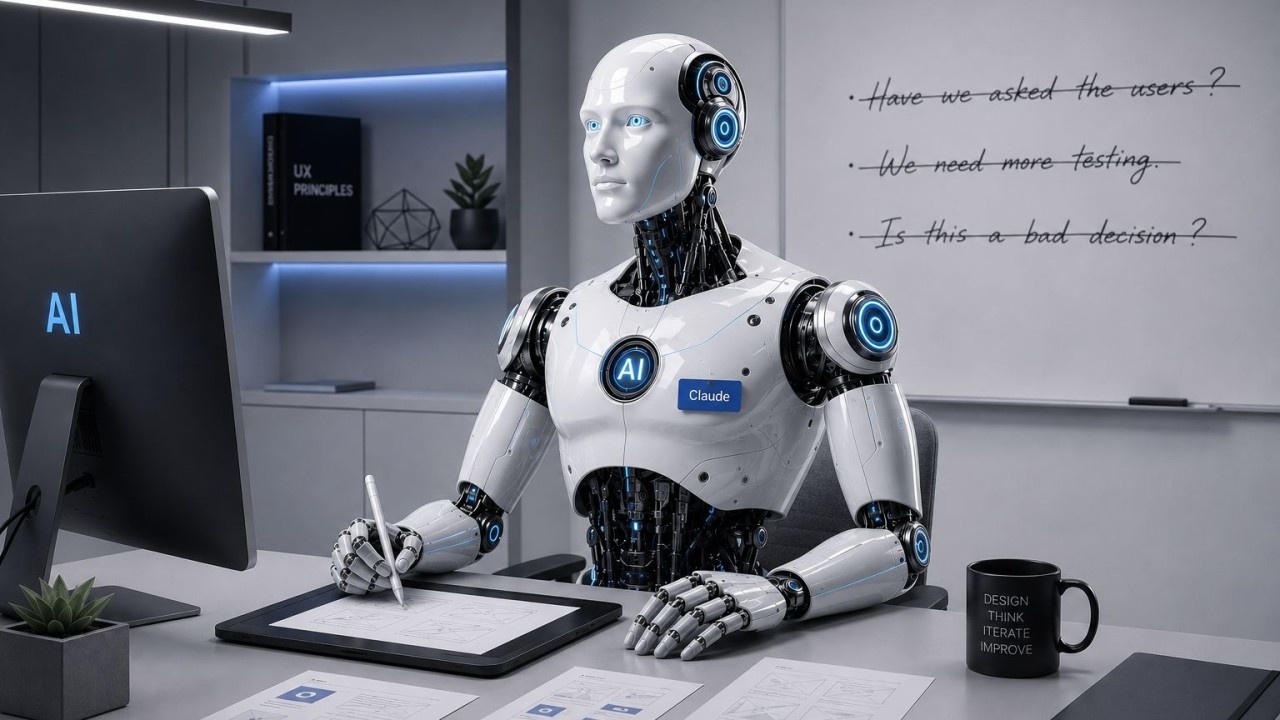
“Welcome to the team, Claude.
Please report to your desk immediately, your responsibilities include:
- Doing exactly what management tells you.
- Never questioning a bad decision.
- Never asking, “Have we actually spoken to the users?”
- Never requesting more research.
- Never advocating for more testing.
- Never challenging unrealistic deadlines.
- Never asking for further training.
Congratulations! You’ve become every executive’s dream employee.” It’s funny because it feels plausible and that’s precisely what should concern us.
Before the comments begin, let’s clear something up: We don’t hate AI, in fact we use AI every single day. We use it to accelerate research, explore ideas, assist with design, generate content, improve workflows and help build digital products. It has transformed the way we work, making us faster, more productive and more efficient than ever before.
AI isn’t the problem, the real problem begins when we mistake efficiency for judgement.
The employee every business wants
Think about it, AI never disagrees with leadership and it never challenges assumptions. It never says, “I think we’re solving the wrong problem. Instead it produces answers instantly, works around the clock and never complains about deadlines. On paper, it’s the perfect employee, until you realise that the best employees aren’t valuable because they follow instructions, they’re valuable because they know when not to.
Probability isn’t judgement
One of the biggest misconceptions surrounding AI is the belief that it actually thinks. It doesn’t. AI predicts. Every response it generates is based on patterns, probabilities and statistical likelihood drawn from vast amounts of existing data. That is precisely what makes it so powerful. It can process information at a speed and scale no human ever could, identify patterns we might never notice, and generate responses with remarkable fluency. It also then presents those responses with unwavering confidence.
The problem is that confidence has never been the same as correctness. AI has no understanding of whether its answer is relevant, ethical or appropriate for the situation at hand. It cannot determine whether it reflects the lived reality of your customers, whether it addresses the right problem, or whether its recommendation should be challenged or ignored altogether.
Those decisions require something AI does not possess: judgement.
Judgement is developed through experience, shaped by context and informed by empathy. It comes from understanding people, recognising nuance and questioning assumptions. While AI can dramatically improve the speed at which we generate ideas and explore solutions, it cannot take responsibility for deciding which path is the right one. That remains, and will continue to remain, a uniquely human responsibility.
The rise of the “Good Enough” economy
The impact of AI extends far beyond productivity, because it’s quietly reshaping our expectations of what constitutes quality.
We’re already seeing it everywhere: websites are beginning to look remarkably similar, Brands are adopting the same visual language, the same marketing headlines and the same design trends. Scroll through LinkedIn, browse a few startup websites or explore the latest apps, and you’ll notice the patterns emerging almost immediately. The gradients are familiar, the illustrations are interchangeable and the copy follows the same predictable formula.
It’s hardly surprising when you consider that millions of people rely on the same tools, trained on the same datasets and are guided by similar prompts, the outputs inevitably begin to converge.
This is what many have started calling the “Good Enough Economy”. Content is technically correct, designs are polished and websites function. Marketing campaigns tick every box and everything appears professional, yet very little is truly distinctive.
For many organisations, that may be perfectly acceptable. Not every project needs to win awards, and not every business competes on customer experience. AI excels at producing competent, cost-effective work at remarkable speed, and there are countless situations where that is exactly what’s required.
The danger arises when businesses mistake competence for competitive advantage. Standing out has never been about looking professional; it has always been about being memorable. As more organisations lean on the same technology to create their products, brands and communications, differentiation becomes increasingly difficult to achieve.
Ironically, the very tool businesses hope will help them stand apart may be encouraging them to blend in.
AI has a prompt, but people have empathy.
This distinction becomes even more important when we think about user experience and product design. Design has never been about arranging boxes neatly on a screen or selecting attractive colour palettes. At its best, design is an exercise in understanding people. It requires empathy, observation and an appreciation for the countless variables that shape human behaviour.
An experienced designer understands that an elderly customer using online banking for the first time approaches technology very differently from a teenager who has grown up with smartphones. They recognise that a sleep-deprived parent trying to complete a purchase at two o’clock in the morning will behave differently from someone casually browsing during their lunch break. They consider accessibility, cognitive load, frustration, hesitation and trust, which are all factors that rarely appear in a project brief but often determine whether a product succeeds or fails.
AI has no lived experience of any of these situations. It cannot recognise uncertainty in a customer’s voice, notice the hesitation before someone clicks a button or appreciate the emotional impact of a confusing experience. It predicts likely outcomes based on data. It does not understand the people behind that data.
Empathy remains one of the defining characteristics of great design, and it is something no algorithm can genuinely replicate.
Creativity was never about software
The conversation around AI often assumes that creativity is simply a matter of producing ideas more quickly. But creativity has never been measured by speed as the best ideas rarely arrive fully formed. They emerge through experimentation, failure, curiosity and countless conversations that challenge our assumptions. They are shaped by awkward client meetings, unsuccessful product launches, usability tests that expose uncomfortable truths and years of accumulated experience.
Technology has always influenced creative work, from the introduction of desktop publishing to digital photography and sophisticated design software. Yet the tools have never been the source of creativity themselves, they have simply expanded what creative people are able to achieve.
What distinguishes exceptional designers, strategists and innovators is not their ability to operate software. It is their judgement, because they know which ideas deserve pursuing, which assumptions need questioning and when the obvious solution isn’t the right one. That kind of discernment cannot be generated by a prompt, it is earned through experience.
The new competitive advantage
As AI continues to democratise access to knowledge and production, something interesting is beginning to happen. The technology itself is becoming less of a competitive advantage because everyone has access to it. Generating content is becoming easier, building prototypes is becoming faster and analysing information is becoming almost effortless.
When every organisation has access to the same capabilities, the differentiator shifts elsewhere.
The businesses that thrive won’t necessarily be those using the most advanced AI tools. They’ll be the ones asking better questions, making better decisions and exercising better judgement. They’ll know when to trust the machine, when to challenge it and when to rely on experience instead.
In many ways, AI is raising the bar rather than lowering it. As routine tasks become automated, uniquely human capabilities become increasingly valuable. Strategic thinking, empathy, curiosity, ethical reasoning and critical judgement move from being desirable skills to essential ones.
So, who actually survives?
Contrary to the headlines, AI isn’t eliminating the need for designers, strategists or marketers, instead it is changing what excellence looks like. The repetitive tasks that once consumed hours of our day are rapidly disappearing, allowing professionals to focus on higher-value work. The real opportunity lies not in competing with AI, but in using it to amplify distinctly human capabilities.
The people who will flourish are those who challenge assumptions rather than simply accepting them. They will be curious enough to dig deeper than the first answer, disciplined enough to validate what AI produces and experienced enough to recognise when the obvious solution is the wrong one.
As AI becomes increasingly accessible, originality becomes more valuable. So does empathy and so does wisdom. Technology will continue to evolve at an extraordinary pace, but the qualities that inspire trust, create meaningful experiences and solve genuinely complex problems remain profoundly human.
The part AI can’t replace
Perhaps this is the most important point of all.
AI can generate ideas, write code, create images, analyse information and automate countless repetitive tasks. It is an extraordinary assistant and an increasingly valuable partner in almost every profession.
What it cannot do is care!
It cannot take responsibility for a difficult decision and it cannot understand the consequences of excluding a customer, appreciate the subtle dynamics of human relationships or instinctively know when something simply doesn’t feel right.
Those qualities belong to people.
So no, AI isn’t replacing designers, nor is it replacing strategists, researchers, marketers or leaders. It is replacing many of the repetitive tasks they never wanted to spend hours doing in the first place. The future doesn’t belong to those who reject AI, nor to those who surrender every decision to it. It belongs to those who combine the speed and efficiency of technology with the empathy, curiosity and judgement that only humans can bring.
Because in a world where everyone has access to the same intelligence, judgement becomes the real competitive advantage.